
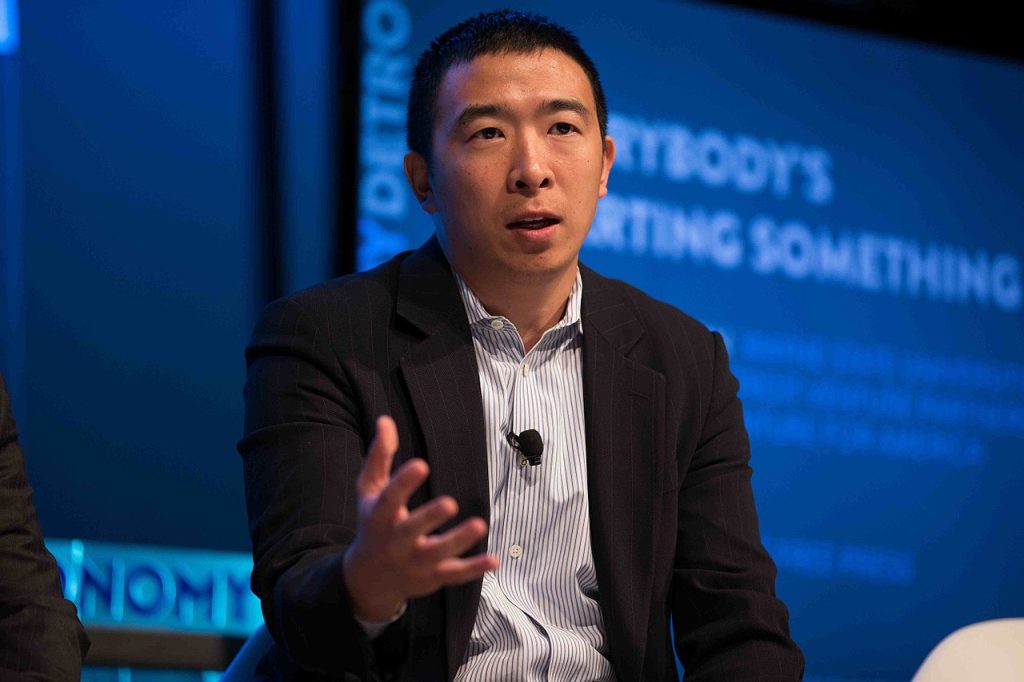
“Seven years ago, Yang warned that the effects of automation might ‘destabilize society’ and even lead to ‘riots in the street.’ Today, he says he sees even more clearly the kind of danger that he warned about, namely that between 30 to 40 million U.S. jobs might disappear within the next ten years because of the power of artificial intelligence,” said CNN’s Fareed Zakaria while introducing a story about Andrew Yang and his thoughts on the looming threat of artificial intelligence.

1. The Extent of The Current AI Capabilities
Recent studies emphasize that the effect of AI is no longer hypothetical. According to the Iceberg Index developed by MIT, the present state of AI is capable of performing skills that encompass 11.7% of the US labor market, translating to $1.2 trillion dollars within the financial, healthcare, and professional services sectors. This is already going beyond the laid-off employees within the technology sector. Internal Amazon strategy papers purport that up to 600,000 employees will not be hired in the US over the next few years, with the long-run vision directed at automating 75% of their operations.

2. Proposal of Yang’s Universal Basic Income
However, his response to this impending displacement is financing a universal basic income of $1,000 per month for each adult in the country with taxes levied on AI companies. Yang looks at concepts such as the “token tax” pitched by Anthropic CEO Dario Amodei, reasoning that companies such as tech giants, which create “hundreds of billions” in value using public data, should pay for the welfare system. Although others argue that the sum of $12,000 per year fails to raise families above poverty levels, Yang insists that this will help establish a foundational level of stability, preventing radicalization in those left behind.

3. Historical Parallels and Rate of Change
Though the headlines are certainly worrisome, significant changes in the labor market associated with new technology have always taken decades. It took a number of years for personal computers and the WorldWideWeb to enter the scene, but eventually, they changed the way people worked. Analysis by Brookings illustrates that the changes in the skill distribution of the occupations of workers have followed the same pattern in the wake of the advent of generative AI, including the suggestion that the potential of AI remains vast but will take time to realize.

4. Vulnerable Occupations and Demographics
Yang’s estimate of 44% vulnerability equates to up to 60% of jobs at risk due to AI in advanced countries. The jobs that are most at risk are Office Support Workers, Customer Service Workers, and Food Service Workers working-class jobs that are dominated by women and minorities. Lower-wage workers are between 7 and 14 times more likely than top-wage workers to require occupational change. That change may require new skills.

5. Psychological Resilience Amid Disruption
Mass layoffs and job changes can cause anxiety, feelings of lost identity, and community disorders. Researchers advise resilience techniques: staying social, getting retraining opportunities early, and viewing changes as skill development, not obsolescence. Learning from the past, such as changes experienced due to the mechanization of farming or the technological revolution, shows that although jobs change, the adaptability of human resourcefulness helps keep purpose intact.

“6. Policy Tools Beyond UBI”
Some complementary policies could help fortify the safety net and assist with transition. These include health benefit portability, shortened vesting requirements for retirement plans, simplified license requirements for career switches, and employee retraining plans with tax-deferred contributions. Earned income tax credits paid every month could help stabilize finances for many families; also necessary is investment in adequate broadband access so that every worker can fully exploit online job resources.

7. Human and AI Collaboration Preparation
According to the Skill Change Index from McKinsey, the current skills utilization level is over 70% in non-automatable tasks as well as in automatable tasks. The level of AI fluency, or the ability to work with AI, has increased by a factor of seven in the last two years in job ads. Future work tasks will be collaborative efforts of humans, AI entities, and robots, where humans will work on decision-making, creativity, and social skills, and robots would perform repetitive tasks.

8. Coordinated Action For An Inclusive Future
However, in order to face this challenge, it would be necessary for all parties to work together. See, for example, how governments can influence “guardrails for protecting workers and encouraging a level playing field,” while companies can look to “enhance hiring to include underserved groups and provide training within their own ranks.”

As Yang’s warning becomes even more pressing, the question is whether to simply react to a crisis or prepare for the future, to construct a system in which the economic benefit of AI would be for everyone, not just a few. The path of AI adoption is not predetermined, nor is it inevitable. With vision, policy creativity, and a commitment to equity, the country can guide this change without losing the livliehoods of millions.


