
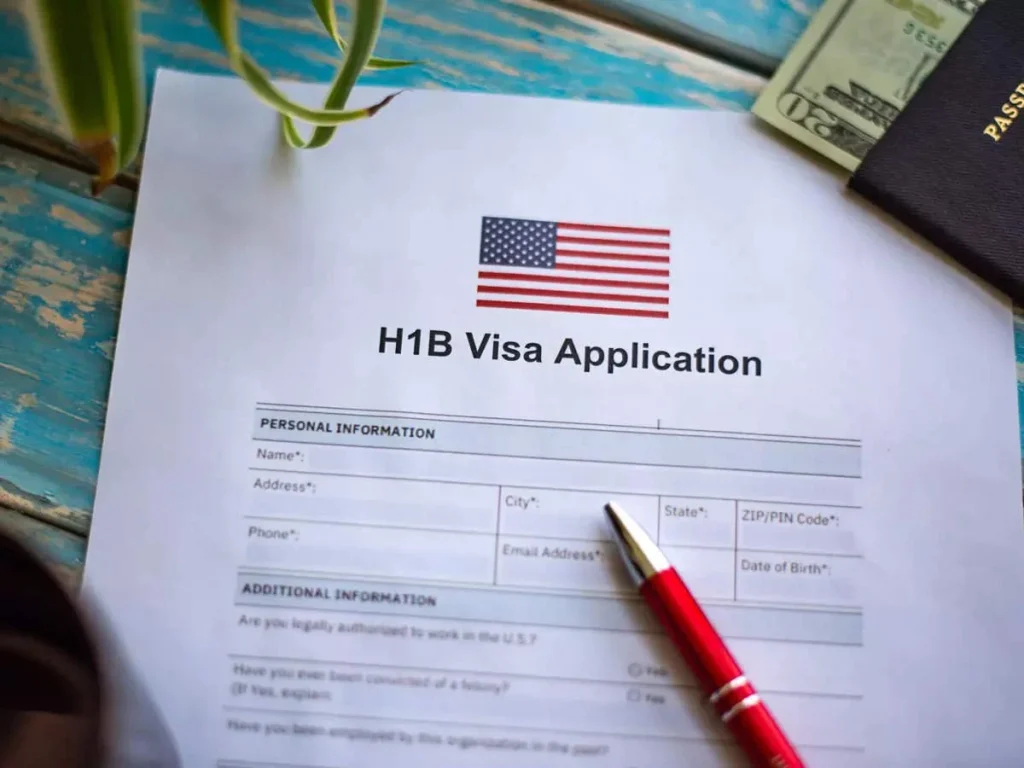
It is not a typical week when a change in policy causes a stir in the boardroom, the hospital staff office, as well as the university human resource office, within the entire state of Indiana. However, the change brought about by President Donald Trump’s imposition of a fee of $100,000 to specific H-1B visa applicants has caused a stir, making a long-term solution to attract the best talent in the world expensive in itself.
Indiana’s tech titans, healthcare systems, and research universities have long relied on highly skilled immigrants to fill a specific niche in their industries. However, new and evolving federal guidelines, politically charged crossfire, and economic uncertainty are causing state leaders to rethink their hiring strategies, budget decisions, and even their state’s ability to compete in the innovation sector. The following listicle will explore nine key challenges and issues affecting the future of the H-1B landscape in Indiana:
1. The $100,000 Fee Shaping Hiring Choices
Effective September 21, 2025, H-1B petitions with a new one-time fee of $100,000 are mandatory for foreign workers who are not in the United States. According to USCIS, this fee shall not apply to H-1B petitions that are being replaced or are already in process. However, this fee is expected to discourage smaller companies from sponsoring H-1B workers. Larger companies can absorb this cost but may choose workers more selectively, only hiring those who qualify for this heavy investment.
For specialty industries in the state of Indiana, ranging from pharmaceutical research by Eli Lilly to engineering by Cummins, it means reduced access for global job seekers. The greatest expected effects are when the spring 2026 H-1B cap season rolls around.

2. Weighted Lottery and Wage Prioritization
The US Department of Homeland Security has decided that the lottery selection based on H-1B will soon become a weighted lottery that gives priority to those that pay higher wages. This will allow only the most talented workers to qualify, but it may also impact entry-level employment at universities and smaller tech companies. The prevailing wage requirements will soon become a priority, which may render talented workers ineligible if they don’t earn a high wage.
This would be a big change in hiring practices for publicly-funded universities in Indiana which prefer to employ associate software engineers or a data scientist right out of college.
3. Legal Challenges and Court Decisions
Numerous lawsuits have challenged the constitutionality of the fee, suggesting that Congress did not grant powers for such fees. In December 2025, U.S. District Judge Beryl A. Howell ruled in support of the policy, making it clear that the president retains broad powers to prevent the entry of non-citizens. There are other cases, including those of 20 states, still pending.
Until the courts provide final clarification, employers in Indiana operate in a period of ambiguity while planning their long-term workforce in relation to international talent.

4. Effects on the Brain Drain Problem in Indiana
Only fewer than 40% of Indiana tech and engineering school graduates stay in Indiana, as Indiana Chamber of Commerce revealed. The drain of talents pushes Indiana employers to look for other talents other than U.S. citizens. The H-1B visa has been an essential remedy, helping to cover positions in AI, the cloud, and healthcare.
A limitation of hiring international experts could further worsen the talent shortage, and Indiana might find it increasingly difficult to sustain its key sectors and secure huge investments, as in the case of SK hynix, with its proposed $4 billion investment in a semiconductor factory, to name one example.

5. Healthcare Sector Vulnerabilities
Nearly 6% of the overall pool of physicians practicing in the United States consist of Indian physicians who work in distant rural areas. In the year 2023, over 8,200 H-1Bs were granted approval for general medicine and surgical hospitals. The charge of $100,000 may multiply the problem of shortages of health care professionals, especially in the rural regions of the state of Indiana.
Hospitals could have to cut back on the kind of care they can deliver or defer an expansion of the facility should the cost of visas become excessive.

6. Changing Employer Trends
Some Indiana firms are already considering other options like L-1, TN, E-3, O-1, and cap-exempt H-1Bs. Other alternatives being pursued by some of these firms are green cards based on work and national interest waivers.
South Bend’s High Skill Immigration Fund, which provided up to $4,000 per sponsored employee, is slowing down because of policy uncertainties. This fund made over $1 million in local economic impact until policy doubts threatened to render it nonviable.
7. The Economic Ripple Effects Beyond Indiana
H-1B visa holders and their family members generate around $86 billion each year for the economy and add $24 billion to federal payroll and $11 billion to state and local tax revenues. Reducing the rate of visa issuances may result in a talent shortage.
For the case of Indiana, which relies upon high-tech manufacturing and research-intensive growth, the ripple effects might jeopardize the state’s economic course.

8. Wage Debate and Market Dynamics
Critics, such as Ronil Hira, contend that prevailing wages are kept low of what the market rates are, which allows employers to shun hiring from within the USA. A supporter of this program, Justin Wolfers, believes it increases productivity and wages of college-educated USA workers.
The new cost and remuneration prioritization policy is aimed at addressing such issues, though it may also reduce the diversification of jobs and sectors being sourced by talent from abroad.

9. “The Human Side of Policy Changes”
Stories such as Nida Ansari’s represent the individual implications of such regulatory shifts. For instance, Nida Ansari was an H-1B visa holder who later attained citizenship and became an innovation guru and businessperson. Nida has established businesses within Indiana State. Her personal experience illustrates the importance of skilled immigrants contributing towards community and economic development. Policies that limit their entry have implications not only for labor shortages but also the loss of future leaders.
For Indiana, its reliance on the H-1B talent pool is more than just a talent supplement – it is essential to its competitive advantage in areas like information technology, healthcare, and education. The $100,000 fee, lottery systems, and focus on salaries may fulfill the objectives of some politicians, but they risk further increasing talent gaps and stifling innovation. The coming period will call for talent, flexibility, and insight from business leaders, politicians, and talented foreigners on how to keep Indiana’s economic machine purring within a talent-constricted global environment.


