Churches often say they welcome honest questions, and many do. Yet worship services run on more than sincerity. They also run on timing, pastoral responsibility, doctrine, privacy, and the unspoken knowledge that some questions belong in a classroom, counseling room, or private meeting rather than the sanctuary.
That tension explains why certain faith questions can feel reasonable and still land badly. The issue is not always the question itself. Often, it is the setting, the people involved, and the risk of forcing a public answer to something that requires care.
1. “Why won’t the church pray about this political issue?”
This question sounds practical, especially when public life feels morally urgent. But in many churches, public prayer is handled with caution because prayer in a service can be heard as public institutional speech, not just personal concern.
For churches in the United States, the line around political campaign intervention matters legally as well as pastorally. Clergy also know that once a prayer names one controversy, the room immediately begins dividing over what was included, what was omitted, and whether the church has just taken sides. A better venue is usually a class, office hour, or conversation where the church can explain its convictions without turning prayer into a referendum.
2. “Can somebody perform an exorcism right now?”
Questions about spiritual oppression carry real fear, which is why they rarely belong in a rushed public moment. In traditions with formal exorcism practice, ministers are not meant to improvise under pressure.
In the Catholic Church, Canon 1172 requires explicit permission from the local bishop for a major exorcism. Even outside liturgical traditions, pastors typically distinguish between urgent pastoral care and dramatic public action. The deeper concern is not spectacle but discernment, accountability, and the protection of vulnerable people.
3. “Can a healthy relative be anointed anyway?”
This kind of request often comes from love. A family member is anxious, aging, or fragile, and someone wants comfort made visible.
Still, the anointing of the sick has boundaries in churches that treat it as a sacramental act rather than a general blessing. The Catechism’s teaching on the Anointing of the Sick ties it to serious illness, danger due to sickness, or advanced age. Asked publicly, the question can corner a priest or pastor into either refusing a grieving family in front of others or seeming to redefine a rite the church has carefully limited.
4. “Why is communion given to some people and not others?”
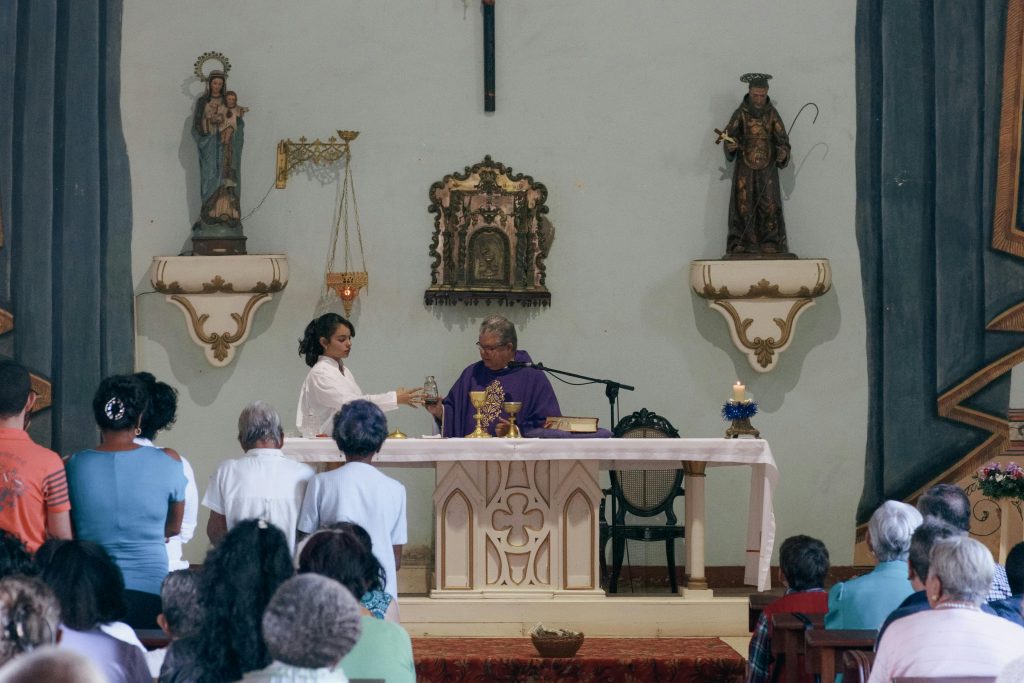
Communion questions touch doctrine, repentance, church discipline, and personal conscience all at once. That is why they can unsettle a congregation faster than expected.
In churches governed by canon law, Canon 915 addresses when Communion may be withheld, but the application is not supposed to become public theater. Even in Protestant settings, pastors usually avoid discussing one person’s spiritual status before the congregation. A worship service is meant to lead people toward reverence, not into speculation about another believer’s soul.
5. “Why is that minister still here after complaints?”
This is often the hardest question in the room because it comes loaded with pain, suspicion, and the demand for immediate clarity. It also touches matters that churches should never handle casually.
When accusations involve staff or clergy, the faithful may want instant transparency. Yet churches also have duties around documentation, investigation, confidentiality, and due process. Publicly pressing the issue during worship can create the appearance that silence means indifference, when in many cases it means the matter is being handled through procedures rather than through microphones. That does not make the concern small. It means the setting is wrong for an answer.

6. “Do members really have to believe every church teaching?”
This is one of the most revealing questions a person can ask, because it exposes the difference between belonging culturally and submitting doctrinally. It also tends to be too large for a quick answer.

Some churches distinguish between central doctrines, secondary teachings, and matters of conscience. Others define more formal levels of assent. Asked in the middle of worship, the question can sound like a live negotiation over authority. Asked in teaching spaces, it can become fruitful discipleship. That distinction matters. As one ministry summary of church conversation put it, going deeper is often simpler than people think when the setting invites care instead of defensiveness.
7. “Do people of other religions go to hell?”
Few questions generate more heat with fewer words. The reason many churches resist answering it casually is that a short reply can distort a large body of teaching. In Catholic theology, Lumen Gentium 16 addresses the salvation of non-Christians with far more nuance than a yes-or-no exchange allows. Evangelical churches face the same pressure from another angle: they may affirm the uniqueness of Christ while still insisting that the question deserves biblical and pastoral depth. Reducing the whole matter to a slogan can harden listeners instead of teaching them.

The real taboo is not curiosity. It is forcing private, complex, or highly charged questions into a public moment built for worship. Churches that handle questions well usually do not silence them; they relocate them to a place where truth and charity can remain intact.
That may be the more useful lesson for thoughtful believers. The healthiest congregations are not the ones without difficult questions. They are the ones that know which questions need a sanctuary, and which need a table, a pastor, and enough time to answer honestly.