
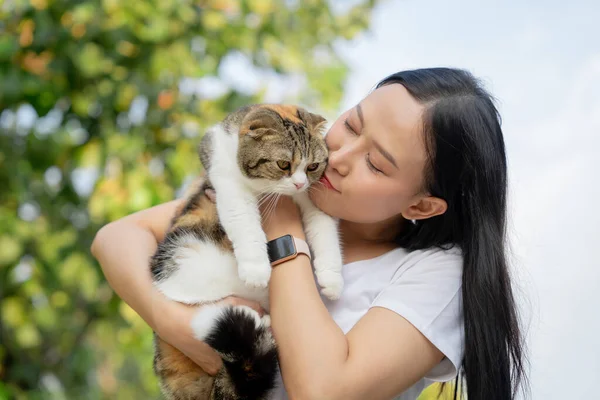
A cat rarely announces concern in dramatic ways. More often, stress in a home is met with a pause, a stare, a changed routine, or a careful decision to come closer or keep distance. Research over the past several years has complicated the old idea that cats are detached observers. Studies suggest they can distinguish human emotions, match faces to voices, and alter their own behavior when tension rises. In other words, a cat may register the emotional weather of a room before the people in it fully name what is happening.

1. The cat watches faces and voices more closely than usual
One of the quietest signals is increased vigilance. A cat may stop mid-groom, lift its head, and study the people in the room when voices tighten or expressions change. That response aligns with findings that cats can match human vocal and facial emotional signals, especially for anger and happiness. In home-based testing, cats looked longer at faces that matched the emotional sound they had just heard. They also showed more stress-related behavior during angry human cues than during happy ones. That kind of attention suggests a cat is not merely hearing noise; it is tracking meaning.
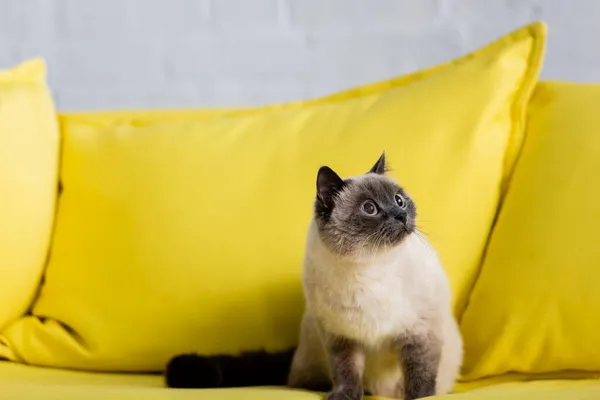
2. The cat goes unusually still during tense moments
Stillness can be a form of reading the room. When a household becomes strained, some cats do not flee or vocalize. They freeze their movement, angle their ears, and wait. This matters because stress sensitivity in cats often appears as subtle body regulation rather than obvious distress.
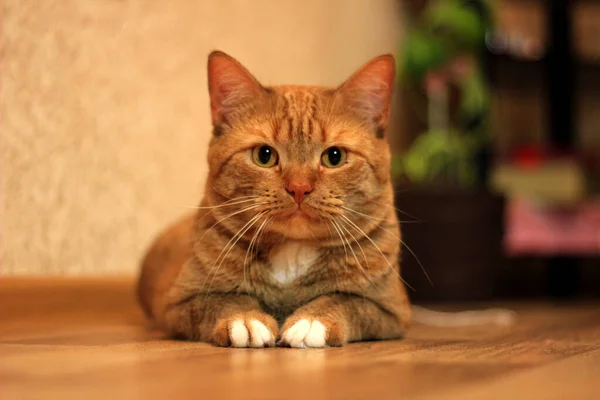
In experiments on emotional recognition, cats displayed higher stress responses to human anger and feline hiss cues than to calmer signals. A motionless cat at the edge of the hallway may be doing exactly what a socially aware animal does when it detects a negative shift: gathering information before acting.
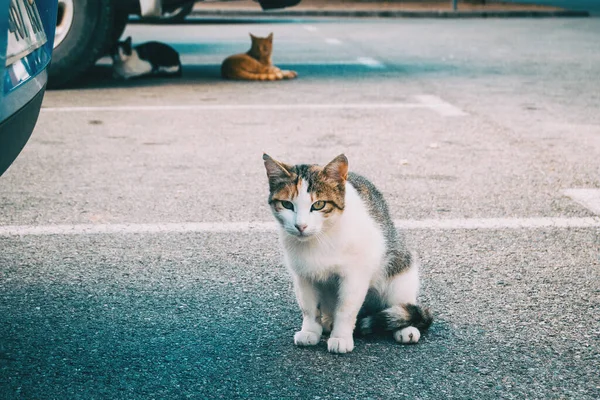
3. The cat changes where it stations itself
A cat that usually naps in the center of family activity may relocate to a doorway, staircase, or high perch when the mood feels unsettled. Another may do the opposite and move closer to one particular person. That repositioning reflects monitoring, not randomness. Cats are known to discriminate between familiar and unfamiliar humans, and their bonds with owners can become highly specific. Some research has found that cats respond differently depending on the emotional state of people around them, including increased engagement with certain human moods. A changed perch can therefore function like a sensor reading: the cat is choosing a place where the emotional atmosphere is easier to assess.
4. The cat becomes more selective about touch
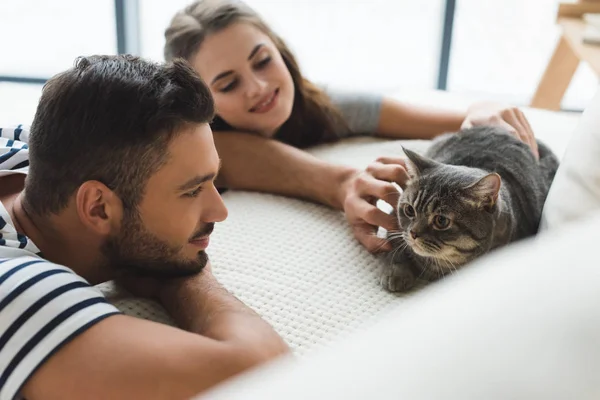
In a calm home, a cat may welcome petting with little hesitation. Under stress, that same cat may lean in for one stroke and then step away, or accept contact from only one household member. This selectivity fits what researchers have described about feline autonomy. In a study of human-cat interaction, everyday contact such as touch, play, feeding, and training all activated the human prefrontal cortex, but cats’ independent reactions shaped the emotional quality of those moments. The authors found that cats’ autonomous behaviors and reactions positively influenced participants. That independence also means a cat may become more precise about touch when a home feels strained, using boundaries to regulate its own comfort.
5. The cat reacts to stress you cannot see, only smell
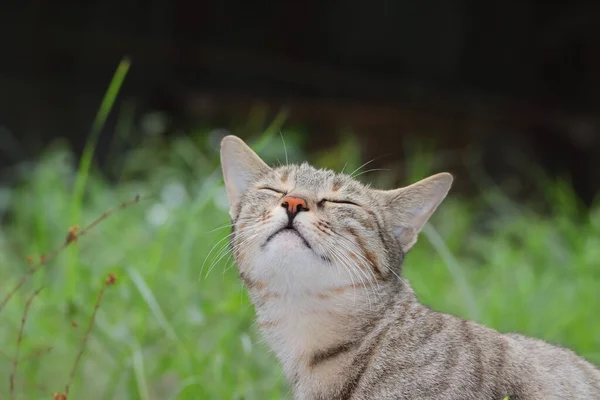
Not all household tension is spoken. Cats also seem responsive to chemical cues linked to human emotion. A recent behavioral experiment described cats showing more severe stress-related behaviors in response to fear odor than to neutral or physically stressed odor samples. The work was conducted in the cats’ home environments, where subtle changes were easier to observe. For daily life, that means a cat may react when a person is holding stress silently, even before conversation or conflict makes it obvious to anyone else in the room.
6. The cat starts testing interaction instead of fully committing to it
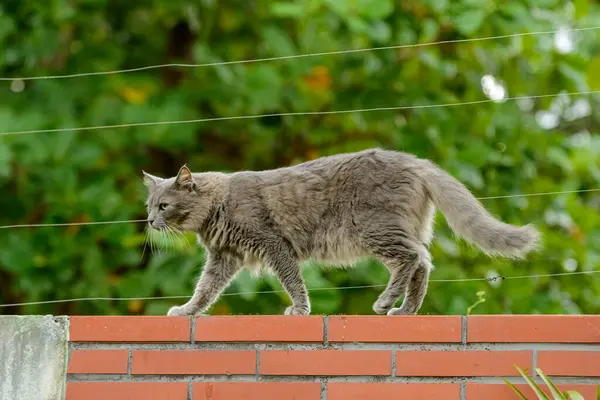
A stressed household can produce a cat that seems half-in, half-out: approaching, pausing, retreating, and then returning. This is not indecision so much as careful social sampling. That pattern echoes research showing that cats are sensitive to human communicative signals and often respond in finely graded ways rather than broad, obvious ones. In the interaction study, even when success rates were lower in play and training, people reported more positive emotion when the exchange worked. The cat’s unpredictability was part of the interaction itself. A cat that “checks in” and then withdraws may be measuring whether the room is safe, settled, and readable.

7. The cat offers quiet contact at oddly specific times
Sometimes the clearest sign is not avoidance but a targeted moment of closeness: sitting nearby after an argument, appearing when someone cries, or settling beside the most unsettled person in the home. There is evidence that cats are sensitive to human moods and emotional cues, and some reports note stronger responses with familiar people than with strangers. Popular summaries of this work often describe cats reacting to visual or auditory cues such as crying. The behavior is usually understated. A cat may not “comfort” in a human-style way, but presence itself can be a form of response close enough to monitor, quiet enough not to add to the tension.
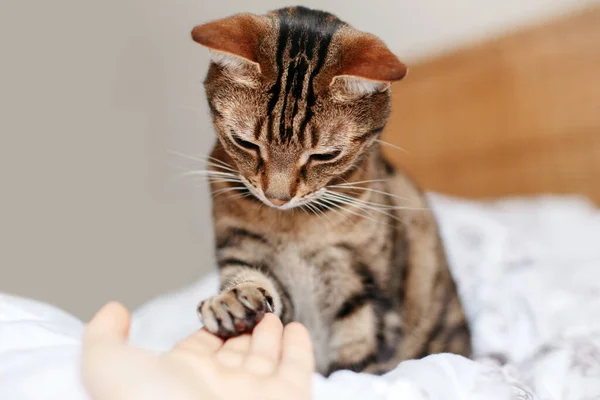
Household stress does not always reveal itself through raised voices or obvious conflict. Cats seem to detect it through posture, tone, routine, and even scent, then answer with behavior so subtle it is easy to dismiss as ordinary feline mystery. Seen closely, those small shifts are often coherent. The watchful stare, the changed resting place, the careful approach, and the altered tolerance for touch can all suggest the same thing: the cat has noticed the strain in the room, and is adjusting long before anyone calls it stress.

