
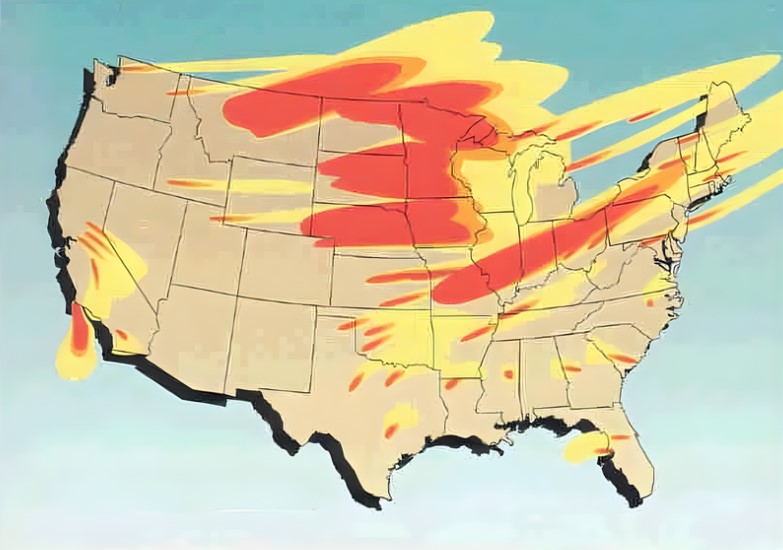
No map can turn nuclear war into a survivable lifestyle choice. Still, fallout modeling has pushed one uncomfortable question into public view: which parts of the United States would face relatively lower exposure in the first days after a strike on inland missile silos?
The answer is narrower than it sounds. Researchers and analysts looking at silo-target scenarios found that distance from the northern Plains missile fields, along with wind patterns, heavily shapes where radiation travels. Even then, experts have stressed that immediate fallout is only one layer of danger, not the whole picture.
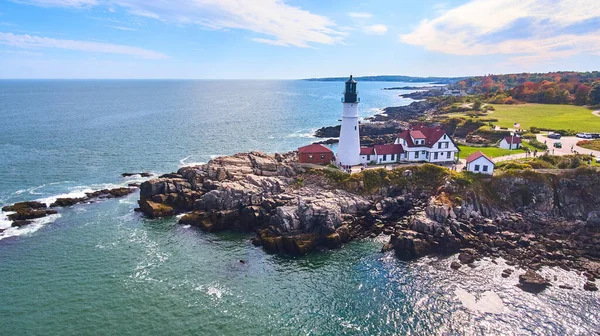
1. Maine
Maine repeatedly appears in the lower-exposure group in silo-strike simulations because it sits far from the dense band of missile fields in the central U.S. In average-case modeling, states in this northeastern cluster fell within 0.001 Gy to 0.5 Gy over four days, far below the levels associated with acute lethality. Geography helps, but so does prevailing airflow that often keeps the heaviest inland fallout from reaching the far Northeast quickly.

2. New Hampshire
New Hampshire benefits from the same broad protective pattern as Maine: distance, coastal position, and lower direct exposure in scenarios centered on missile silos rather than cities. In worst-case wind conditions from one modeled day, it still remained inside the lower band of states projected at 0.1 Gy to 2 Gy. That does not make the state insulated from food disruption, infrastructure stress, or long-term contamination concerns.

3. Vermont
Vermont stands out because it lands in the lower-risk group in both average and harsher wind-driven scenarios. That consistency makes it one of the more stable entries in these maps. It also shares a trait that appears in other lower-exposure states: it is removed from the silo belt running through parts of Montana, Wyoming, Nebraska, and the Dakotas, where near-field fallout can become extreme within days.

4. Massachusetts
Massachusetts shows up as relatively less exposed in the same modeling set, largely because the scenario examined fallout from attacks on missile silos rather than a broad strike on every strategic target. That distinction matters. One engineering expert told Newsweek he believed Washington, D.C., might prove a more likely strike point in some circumstances, which would redraw the map entirely.

5. Rhode Island
Small size does not change Rhode Island’s placement in the lower-exposure corridor along the Northeast coast. In these scenarios, being far from the primary silo targets matters more than acreage. The state’s inclusion also underscores a central point of the maps: relative safety in the first four days is a radiation measure, not a guarantee about medicine, transport, power, or clean water afterward.

6. Connecticut
Connecticut is another state that benefits from eastern distance and favorable positioning in the modeled plume paths. Its appearance alongside neighboring New England states suggests that the region functions more like a lower-risk zone than a one-off outlier. Even so, lower fallout estimates do not erase the broader environmental risks linked to smoke, fire, and atmospheric debris after nuclear detonations.

7. New York
New York falls within the lower-exposure group in silo-focused simulations, though that broad label says little about how risk could vary inside the state. The useful takeaway is not that New York is “safe,” but that it is less exposed than the states nearest the missile fields in the Midwest and northern Plains. Scientists generally regard doses above 8 Gy as lethal, while the most affected states in the modeling reached dramatically higher peaks than the East Coast states.

8. New Jersey
New Jersey’s position on these maps comes from the same basic physics: fallout travels with weather, and the heaviest plume is concentrated closer to the strike zone. A long paragraph in any nuclear discussion eventually arrives at the same limit. Immediate radiation is only one hazard. John Erath of the Center for Arms Control and Non-Proliferation said, “Nowhere is truly ‘safe’ from fallout and other consequences like contamination of food and water supplies and prolonged radiation exposure.” That warning matches older research into weather and climate effects from nuclear detonations, which has long examined how debris and fires could alter conditions far beyond blast areas.
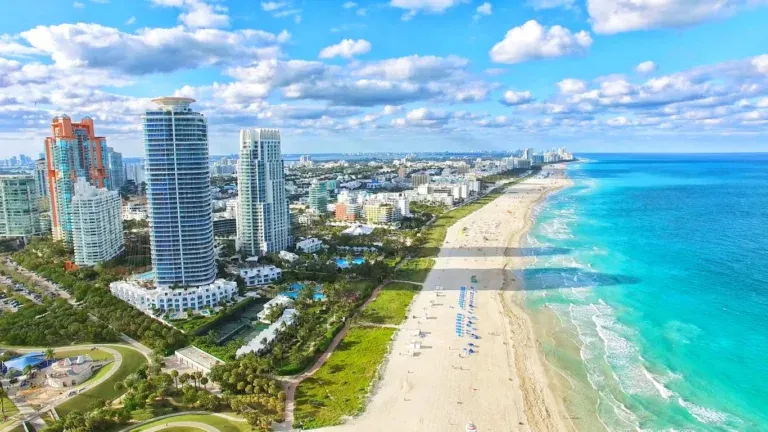
9. Florida
Florida appears on the lower-exposure list in the average-case and worst-case silo models despite its distance from New England. The reason is not shelter from all disaster, but relative separation from the inland missile fields and the direction of modeled fallout movement. For readers comparing maps, Florida is a reminder that a low-fallout state in one catastrophe model may still carry other long-term vulnerabilities, from storms to infrastructure strain to population pressure.
The states above share a pattern, not a promise. They sit farther from the missile-silo targets that dominate the central U.S. scenario, and they often benefit from winds that do not immediately carry the densest fallout their way. That narrow finding should not be mistaken for a survival blueprint. Researchers examining the longer climatic effects of nuclear conflict have revisited the risk of “nuclear winter”, including severe agricultural and food-supply disruption. The maps identify lower initial exposure. They do not identify a place untouched by the consequences.

